




What Is Classic Literature? Timeless Stories That Get Kids Thinking
Classic literature can take a family conversation in unexpected directions. After a chapter, your child may ask if a rule was fair or why a character kept a promise that cost them something. Those questions can lead to conversations about freedom, personal responsibility, fairness, work, courage, and the consequences of one's choices.
These books have been read across generations, and you may be thinking about introducing some of them to your own kids. But what is classic literature, exactly, and where should your family begin? With so many books written for different audiences, choosing titles your child is ready for can take some thought.
In this article, we’ll explain what counts as a classic. We’ll also recommend titles that explore subjects that prepare your child for the real world, such as independent thinking, value creation, questioning unfair rules, and making good choices.
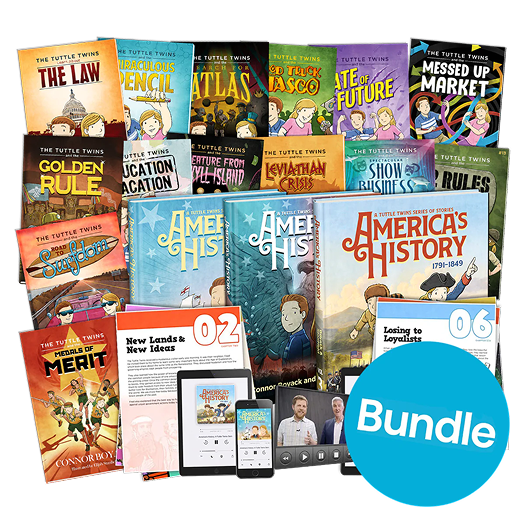
Fiction Books for Kids
Fun and vibrant images that portray concepts uniquely
Shop NowWhat Is Classic Literature?
“Classic literature” doesn't refer to a particular list of books. It's a term used to describe books and other works that people across several generations have continued to read because of their lasting influence and ideas.
If you explain what classics are to your child this way, they may ask who decides which books are called classics. You can clarify that classic books earn broad recognition over time for different reasons. Some were read widely while the author was alive and are still in many libraries today. Others have influenced the literary world in some way, such as being one of the first to explore social issues or a side of human nature.
“So…old books?” Your kid may want to know.
And that's the part where the description of classics gets a bit tricky. Age alone doesn't make a book a classic. A novel published two hundred years ago may disappear from public memory, while another continues to be read, discussed, adapted, and debated. The reason why many classics are old is that enduring influence is what makes a classic, and for a book's influence to endure, it's usually, well, old.
Besides classic novels, there are classic plays, poetry, essays, short stories, and nonfiction. Classic literature also covers an enormous range of writers and perspectives. A broad list of authors of classics might include Jane Austen, Charles Dickens, George Eliot, Mark Twain, James Joyce, George Orwell, Richard Wright, James Baldwin, Virginia Woolf, and Toni Morrison.
From the list of classic books below, you can choose stories that reflect ideas worth discussing at dinnertime. Most of them are suitable for family reading sessions, with a few to reserve for when your kids grow into older teens.

[Photo by RapidEye from Getty Images Signature on Canva.]
Classic Books About Thinking for Yourself
From these books, your child can learn to ask questions to get facts straight and form independent conclusions based on actual evidence. They'll also understand that it's okay to adjust their goals when things change.
The Phantom Tollbooth by Norton Juster
Milo is a bored young boy for whom learning isn't too exciting. A mysterious package containing a miniature tollbooth arrives in his room. He assembles it, gets into his toy car, chooses a destination on the map, and drives through the tollbooth.
His adventure takes him to the Lands Beyond, where he learns the importance of numbers, words, time management, and logic. As he moves from one part of the Lands Beyond to another, he solves different problems with other characters. He returns to the real world now aware of how much there is to explore in it.
Milo’s arc from being bored with learning to loving it can show younger kids that words and numbers can become more interesting when they see what those things can help them understand and do.
Anne of Green Gables by L. M. Montgomery
Anne Shirley has a strong sense of imagination, bold opinions, ambitious plans, and a habit of enthusiastically making mistakes. As she grows up, her experiences gradually make her less impulsive and more responsible, while she becomes more dedicated to working towards her ambitions.
She eventually excels in her studies and wins a scholarship, but she chooses to stay closer to home to care for one of her adoptive parents, Marilla, whose eyesight deteriorates. Her choice comes with a different future than she imagined, but she chooses to adjust her priorities when circumstances change.
Continue Exploring With Tuttle Twins
If your kid enjoys Milo’s character development, you can add The Tuttle Twins and the Education Vacation to your family library. It examines how children can discover their interests and seize opportunities to learn new things outside of the classroom.
The Tuttle Twins and the 12 Rules Boot Camp takes your family on a journey to uncover how discipline and personal responsibility can help people live more productive lives, mirroring how Anne worked toward her academic goals through consistent effort.
Classic Books About What Makes Rules Fair
Your child is living in a world governed by rules, and you'd probably love for them to understand that a rule isn't automatically fair because it's a rule. These classics can help. They examine what happens when rules are unfair to the ruled and get children thinking about why people sometimes question rules they believe violate others’ rights.
The Prince and the Pauper by Mark Twain
Edward Tudor and Tom Canty, two boys from opposite ends of English society, swap places. Edward, the prince, experiences life as an ordinary citizen and realizes how unfair the kingdom's laws are to ordinary people. This discovery inspires him to rule justly when he assumes the throne.
This story can help your child see that a rule being obeyed isn't the same as it being just. They can ask questions like: Does this rule protect everyone equally? What happens when the rule maker doesn't have to comply with the rule? Through this lens, they can assess the fairness of real-world laws.
Animal Farm by George Orwell
The animals collectively overthrow Mr. Jones, the original “ruler,” hoping to run the farm under fairer rules. Over time, the pigs gain increasing control. The principles that supposedly apply to everyone begin changing, and the animals struggle to remember what the rules originally said.
This fable can work better for your older teens, as they're mature enough to appreciate the portrayal of the animals’ loss of freedom and growing inequality. You can provide more context about the Russian Revolution and Soviet rule (the historical events on which the book is based) to assist them with connecting the animals’ experiences to real historical events.
Continue Exploring With Tuttle Twins
The principles in Animal Farm and The Prince and the Pauper get broader treatment in The Tuttle Twins Learn About the Law and The Tuttle Twins and the Leviathan Crisis.
From the former, your kid can learn that they have rights that rules should protect, while the latter examines what happens when the government becomes extremely powerful and how that extra power can affect their freedom.
Classic Books About How Your Choices Affect Others
The choices children make can affect the people around them in ways they may not always notice. These stories can help them think about how their kindness and demonstrations of responsibility influence others, especially when someone is counting on them.
Black Beauty by Anna Sewell
This book is written from the perspective of a horse who has different owners at different points. He first works as a carriage horse for a wealthy family, who treat him nicely, before he's sold to other people. Some treat him thoughtfully while others aren't as kind.
The book is a social commentary on the treatment of working horses of that era, but beyond that, your family can talk about how an individual’s actions affect others around them. A question for the dinner table can be: “Can you think of a time someone was counting on you? How did your choice affect them?”
The Railway Children by E. Nesbit
When their father suddenly disappears, Bobbie, Peter, and Phyllis move with their mother from their comfortable home in London to live a much simpler life near a railway. Their family has fewer resources, yet the children repeatedly seize opportunities to help other people.
They prevent a railway accident, assist people in trouble, and form relationships with members of their new community. Their mother also works to support the family through her writing.
Characters in this story remain generous to those around them even when their financial situation isn't as great as it used to be, proving that responsibility doesn't have to be extravagant for it to yield results.
Continue Exploring With Tuttle Twins
Further your family conversation about making good choices with The Tuttle Twins and the Golden Rule, where the twins learn the importance of treating others the way they'd like to be treated. You can check our blogs on teaching kids empathy and responsibility for simple ways to help your kids apply these lessons in everyday life.

[Photo by pixelshot on Canva.]
Classic Books About Creating Value Through Your Own Work
Classic literature also touches on the value of offering something others are willing to pay for. These books highlight how a free market economy allows sellers to decide what to charge while buyers decide they’re willing to pay.
Farmer Boy by Laura Ingalls Wilder
Farmer Boy is based on a year in the life of Wilder's husband, Almanzo. At age nine, Almanzo has to help out on the farm, milking cows and feeding the animals, carrying logs, and training oxen.
In one scene, he negotiates the price of hay, smartly starting from a higher amount so that the buyer would counter with his (Almanzo’s) preferred amount. He gives every cent to his father, who rewards his business skills with a gift. Almanzo puts the gift into the bank and learns that the bank can keep it safe and give him interest on the sum. This scene can be particularly useful for teaching kids about money, including where it comes from and how to manage it.
Atlas Shrugged by Ayn Rand
Railroad executive Dagny Taggart and steel producer Hank Rearden try to keep their businesses afloat while increasingly strict government policies limit what they can produce and control the prices they can charge.
This classic novel for older teens can open a discussion about how regulation of voluntary exchange can affect people who are trying to trade.
Continue Exploring With Tuttle Twins
The Tuttle Twins and the Search for Atlas is based on Atlas Shrugged, but much shorter. Your child can finish it before dinner and come to the dinner table with a better understanding of why people are more willing to work when they’re free to benefit from the value they create.
Classic Books About Making Good Choices in Tricky Situations
A character can easily do the right thing when it costs them nothing. Stories that show children that making good decisions, such as choosing to be kind or honest, is possible even when it's hard.
Little Women by Louisa May Alcott
Little Women follows Meg, Jo, Beth, and Amy March as they grow up and make decisions about family, work, money, ambition, relationships, anger, and generosity.
That makes the novel especially useful for discussing character as something built through repeated choices rather than one heroic moment. Jo has to learn to manage her temper. Amy has to reckon with selfish decisions. Meg has to make choices about money and the life she wants. The sisters make mistakes and see the consequences of those mistakes.
As your kid moves along with each character on their journey, they learn that good people may not always make perfect decisions, but what matters is a conscious effort to improve.
Pride and Prejudice by Jane Austen
Of Jane Austen’s books, Pride and Prejudice is often recommended for new classic readers and offers a particularly useful lesson about independent judgment. Elizabeth Bennet forms strong opinions about Mr. Darcy and Mr. Wickham, but later receives information that forces her to reconsider what she believed.
Elizabeth has to make important judgments about people and marriage while dealing with strong first impressions, incomplete information, family pressure, money, reputation, and social class. Her mistakes show younger readers that good decisions can require reconsidering what you thought you knew when new information comes to light.
Continue Exploring With Tuttle Twins
Teens can continue exploring how people make difficult judgments with The Tuttle Twins Guide to Beware Your Bias, which shows how assumptions and biases can affect the way we interpret information and make decisions. The Tuttle Twins and the Play for Power lets readers put their own judgment to work by making decisions for Ethan and Emily and seeing how those choices lead to nine possible endings.

[Photo by Vitaly Gariev from Pexels on Canva.]
How to Read Classics With Your Kids
Classics can run long, but your family doesn't need to finish every one. Give each child enough room to understand what's happening in each story and form their own opinions about the events and characters, one book at a time.
Start With a Classic Your Child Enjoys Now
Present age-appropriate options, but allow your child to select the book they want to start with. For example, younger kids can choose from The Phantom Tollbooth, Farmer Boy, The Prince and the Pauper, and The Railway Children. Older children might be keen on titles such as Little Women and Atlas Shrugged.
Give Them Enough Context Before They Read
You don't have to spoil the book. A few sentences about the book's setting or the author's era helps your child know the angle from which the author has written. With this information, they're better prepared to appreciate the book's contents.
Pause to Discuss Characters’ Decisions
Many classics are beautifully written, and there are several points where the main characters make interesting choices. Ask your child, “What might you have done if these were the only options available to you?”
Encourage Your Child to Share Their Conclusions
Classics explore many ideas. Ask your child what they agree with, what they challenge, what evidence from the story supports their conclusion, and which paths they feel should've been taken instead. These questions help them think independently and support their opinions with evidence.
More Classic Books to Read with Your Older Children (15+)
As your child grows, you can suggest classics that explore the themes that matter to your family in a more mature way. You can start with something from this list.
- F. Scott Fitzgerald’s The Great Gatsby (1925)
- Charlotte Brontë’s Jane Eyre (1847)
- Herman Melville’s Moby-Dick (1851)
- H. G. Wells’s The Time Machine (1895)
- Miguel de Cervantes’s Don Quixote (1605, 1615)
- Mikhail Bulgakov’s The Master and Margarita (1966–1967)
- James Joyce’s Dubliners (1914)
- Charles Dickens’s Great Expectations (1861)
- George Eliot’s Middlemarch (1871–1872)
- Mark Twain’s The Adventures of Huckleberry Finn (1884)
- Agatha Christie’s novels (1920–1976)
- Henry James’s The Portrait of a Lady (1881)
- Edith Wharton’s The Age of Innocence (1920)
- Daphne du Maurier’s Rebecca (1938)
- Franz Kafka’s The Metamorphosis (1915)
- Henry James’s The Turn of the Screw (1898)
- Ernest Hemingway’s The Old Man and the Sea (1952)
Conclusion
Classic literature can be a rich source of ideas for your family to discuss at the dinner table. Because these books explore big questions through characters, conflicts, choices, and consequences, a story can stay with your child long after the reading session ends. They may come back with a different opinion about a character’s decision, connect an event in the book to something they have experienced, or raise a question neither of you considered while reading.
Tuttle Twins books and resources bring many of these same questions about freedom, responsibility, judgment, work, and consequences into modern stories and situations that kids can more easily connect to their own world. Reading both gives your family different ways to return to the same ideas as your child grows and develops their own views. And that conversation can continue around the dinner table with a simple question: “What would you have done, and why?”