
When a public figure makes an announcement on a Sunday evening, it is almost never good news.
Jerome Powell, the Chairman of the Federal Reserve, shared a video last night announcing that he is under criminal investigation by the DOJ.
It’s no secret that President Trump is not a fan of the Chairman. He’s criticized him a lot—especially in the last few months as inflation hasn’t cooled as quickly as he’d anticipated when he took office a year ago and promised to bring prices down.
Powell says this is a power-play by the President to try to intimidate the Fed into lowering interest rates. Trump says he doesn’t know anything about the investigation, but that if Jerome feels pressured, it’s pressure from the American people who are suffering.
I’m certainly not a fan of the DOJ being weaponized, and I hope that isn’t what is happening here, but I also would not shed a single tear if Powell lost his job, and the Fed was shuttered forever. Nearly every problem this country has can be traced in some way back to the existence of the Federal Reserve.
That is not an exaggeration.
Word on the street is that the President’s end goal is actually to bring the Fed under government control and end its independent standing. (“Independent,” a word which here means “can’t be audited, and answers to literally no one.”)
Sen. Thom Tillis, R-N.C., who serves on the Banking Committee, released a statement last night saying, “If there were any remaining doubt whether advisers within the Trump Administration are actively pushing to end the independence of the Federal Reserve, there should now be none.”
I guess if we can’t end the Fed, bringing it under some type of oversight would be better than nothing. Maybe then Massie and Paul could finally get it audited. They’ve been trying for decades with no success.
Shocking, I know.
It all reminds me of one of my favorite memes:

Still, there’s something else at play here that deserves discussion.
Every time interest rates make the news, I’m reminded how confused politicians and economists (and most Americans) are about what they’re actually looking at.
The past week actually gave us two perfect examples.
First there’s the investigation into Powell, which offers another reminder that the most powerful price-setting institution in the world is run by political appointees (who are insulated from voters and oversight) and is treated as if it were some kind of neutral, scientific authority rather than what it actually is: a central planning committee.
Then, in equally clown-world news, President Trump announced plans to curb so-called usury by capping credit card interest rates.
This is an idea that sounds compassionate (and polls well with voters who are understandably frustrated by high debt costs) but that has no footing in any kind of sound economic reality.

Both of these approaches share the same underlying flaw.
They assume that interest rates are something that should be decided.
Whether it’s a Fed chair tweaking levers behind closed doors or a president announcing a hard cap from a podium, the premise is identical: prices don’t emerge from real people making real choices in real markets—they should be set by people in charge.
That’s just not how it works.
Interest rates aren’t arbitrary numbers; they’re signals.
They reflect risk, time preference, scarcity, inflation expectations, and a thousand other pieces of information no committee can ever fully know. When those signals are distorted by money printing, political pressure, or legal ceilings, the result is never fairness and prosperity. It’s shortages, misallocation, and unintended harm—usually to the very people the distorters are supposedly trying to help.
Capping credit card rates doesn’t make borrowing cheaper for everyone. It simply makes borrowing unavailable for the riskiest borrowers, pushes costs elsewhere, or drives lending into darker corners where transparency and consumer protection disappears.
History is full of examples of “anti-usury” laws doing exactly the opposite of what was promised.
The Federal Reserve is probably the best example of this. Its very existence depends on the idea that a small group of experts can outthink millions of market participants and “manage” something as complex as the price of money.
Every boom-bust cycle of the last century has been shaped—if not outright caused—by that arrogance.

This pattern is why we wrote The Tuttle Twins and the Creature from Jekyll Island.
It’s based on G. Edward Griffin’s The Creature from Jekyll Island which details the secret meeting of bankers and politicians that ended in the creation of the Federal Reserve and changed all of our lives forever. It’s a must-read for any adult who didn’t learn this stuff in school (so basically all of us).
Look, I know we’re not going to turn kids into mini-economists, (although would that really be so bad?) but we can certainly help them understand a simple truth most adults never learn: when money and interest rates are centrally controlled, the game is rigged. It’s rigged in favor of the biggest banks and the most politically connected players.
And that’s pretty important.
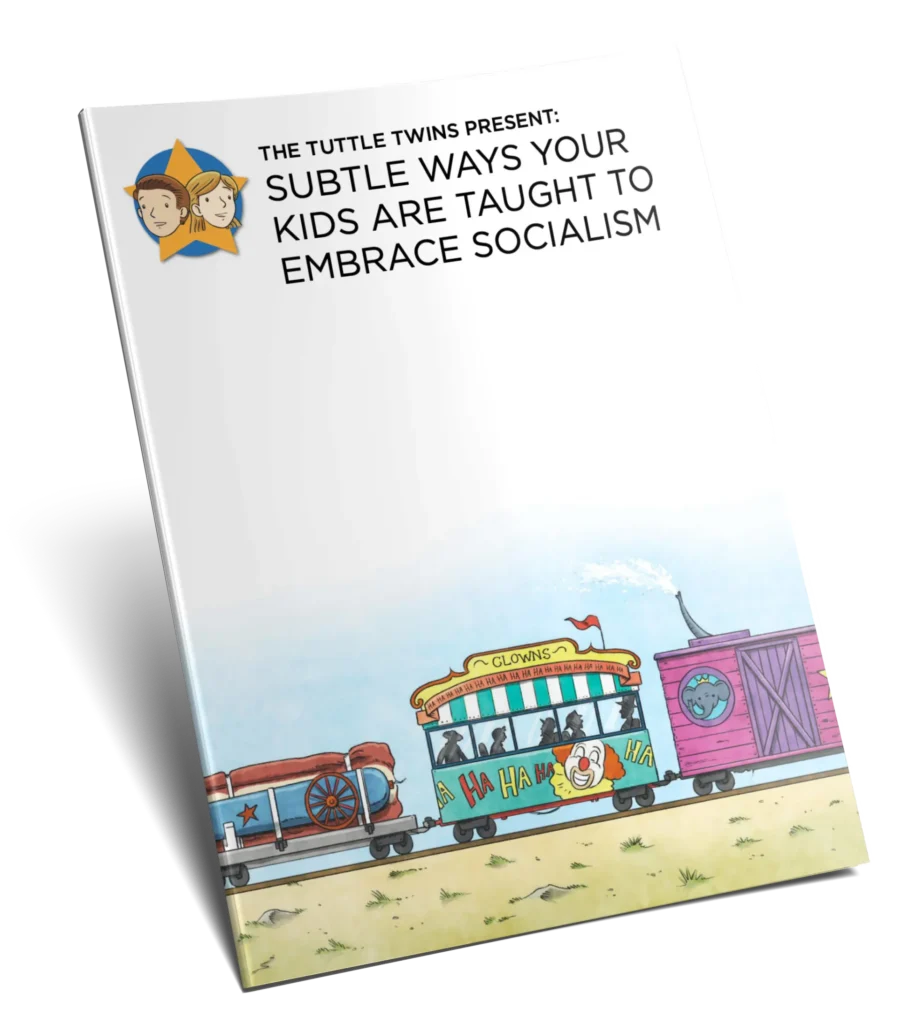
It’s also why we created a short PDF on the Subtle Ways Your Kids are Taught to Embrace Socialism without ever actually hearing the word. Price controls. “Free” money. Government fixes for problems government helped create. By the time those ideas show up in adult politics, they already feel normal to most people.
We want that to end.
None of this is about left versus right—it isn’t a political issue. The Fed isn’t conservative or progressive, and neither are interest rate caps. They’re both expressions of the same belief: that markets are too chaotic, and people too irresponsible, to be trusted with freedom.
We disagree.
If we want a healthier economy and a peaceful, prosperous future, then we are going to need a generation that actually understands how it all works. We have to stop treating central planning as compassion and start teaching kids how voluntary exchange is our best chance at the future we all want.
That work doesn’t start in Washington; it starts at home.
It can start today.
— Connor