




The Best Homeschooling Resources for Every Age Group (A Parent's Honest Guide)
It's a Tuesday afternoon, and you're surrounded by three curriculum catalogs, seventeen browser tabs, and a Facebook group thread with 200 conflicting opinions. You wanted to homeschool so your kids could understand how the world really works, and you were excited about it, but somewhere between curriculum catalogs and conflicting advice, that clarity got buried.
The problem isn't a shortage of homeschooling resources, but rather a shortage of the right resources. The ones that match where your child is developmentally, fit your family's values, and teach your kids about real-world issues.
The purpose of this guide is to set you in the right direction. It's organized by age group, so you can skip straight to what's relevant for your kids. Every recommendation here comes from Tuttle Twins' hand-picked collection on the Homeschool Hub. These recommendations are built around one simple belief: children deserve to learn how to think for themselves, not just what to think.
What Makes a Homeschooling Resource Worth Your Time and Money?
The wrong choice of resources can make homeschooling feel like a chore for you and your child. Before discussing the specific picks we have for you, it's important to know the criteria that define great homeschooling resources. Let's start by discussing them below.
Developmentally Appropriate Content
A resource that doesn't match your child's developmental stage will only frustrate everyone involved. An eight-year-old who has to push through content designed for middle school might get confused during the lesson. Likewise, a ten-year-old handed preschool-level material could easily get bored and disengage. The best homeschooling resources are built for the way children learn at each stage, and meet them exactly at their level.
Aligned with Your Family's Values
Look for materials that present ideas involving institutions, history, and how the world works while also openly inviting your child to think. Resources like these build kids who can hold their own in conversation, evaluate arguments, and make decisions based on actual understanding. For many parents, finding a curriculum that reflects their values while still building critical thinking skills is the most important part of the curriculum selection process.
Flexible Enough for Your Family
Homeschooling takes a different approach in every household, and the right books should mirror yours. What works in real homes is a standalone curriculum or a book that can supplement other topics and ideas you're teaching your child. Many home educators also find it helpful to mix in free resources, such as free YouTube videos, library visits, and nature walks, alongside their core materials to keep learning fresh.
Engaging Enough That Kids Want to Learn
In most cases, story-based learning would outperform worksheet-only approaches and improve engagement. Hands-on curriculum and printable activities can also go a long way in keeping young learners interested. If your child dreads pulling out the curriculum, then it's not the right resource, regardless of how many stars it has in a homeschool review group. The goal is learning that fits naturally into the rest of the day, dinner conversations, and even questions before bed.
Best Resources for Homeschool Families: Toddler and Preschooler Bundle
The early years of schooling are about building curiosity and strong foundations. The best resources for toddlers and preschoolers are those that give your child their first exposure to big ideas in a way that feels natural during everyday moments, such as bedtime stories or quiet afternoons together. Our best pick here is:
Tuttle Twins Toddlers Book (Ages 6 and Below)

Most board books teach colors, shapes, and animal sounds, but the Tuttle Toddlers bundle takes things a step further. These sturdy, colorful books introduce foundational concepts such as letters, numbers, and even the Bill of Rights through colorful illustrations sized perfectly for little hands. Early literacy starts with what children hear and see in their earliest years, and these books make that foundation meaningful.
They're designed to make big ideas feel completely natural to a child who is still learning to talk. Read them at naptime, bedtime, or any time you've got five minutes and a curious toddler in your lap.
Why We Love It:
- Introduces big concepts such as numbers or primary mathematics, letters, the Bill of Rights, and basic economics through colorful illustrations for your little ones.
- The ABCs Combo Set and 123s Combo Set bring meaningful ideas to children who are still learning to talk.
- Short enough to fit nap-time rhythms and short attention spans, as each session can run 20 to 30 minutes.
- Perfect for read-alouds where older siblings can participate and quietly reinforce their own understanding.
- No prep required. Open and read, and that's it.
These books lay the groundwork for everything that follows. Children who grow up hearing words like liberty and responsibility in their earliest stories absorb them as natural parts of how the world works.
Get the Tuttle Toddler Books today.
Best Homeschooling Resources for Children (Ages 5–12)
The elementary and middle school years are when homeschooling becomes more interesting. Kids at this stage are natural learners; curious, social, and hungry for stories. The resources that work best here are those that teach real ideas through characters and adventures that they care about.
Tuttle Twins Children's Book Series (Ages 5–11)
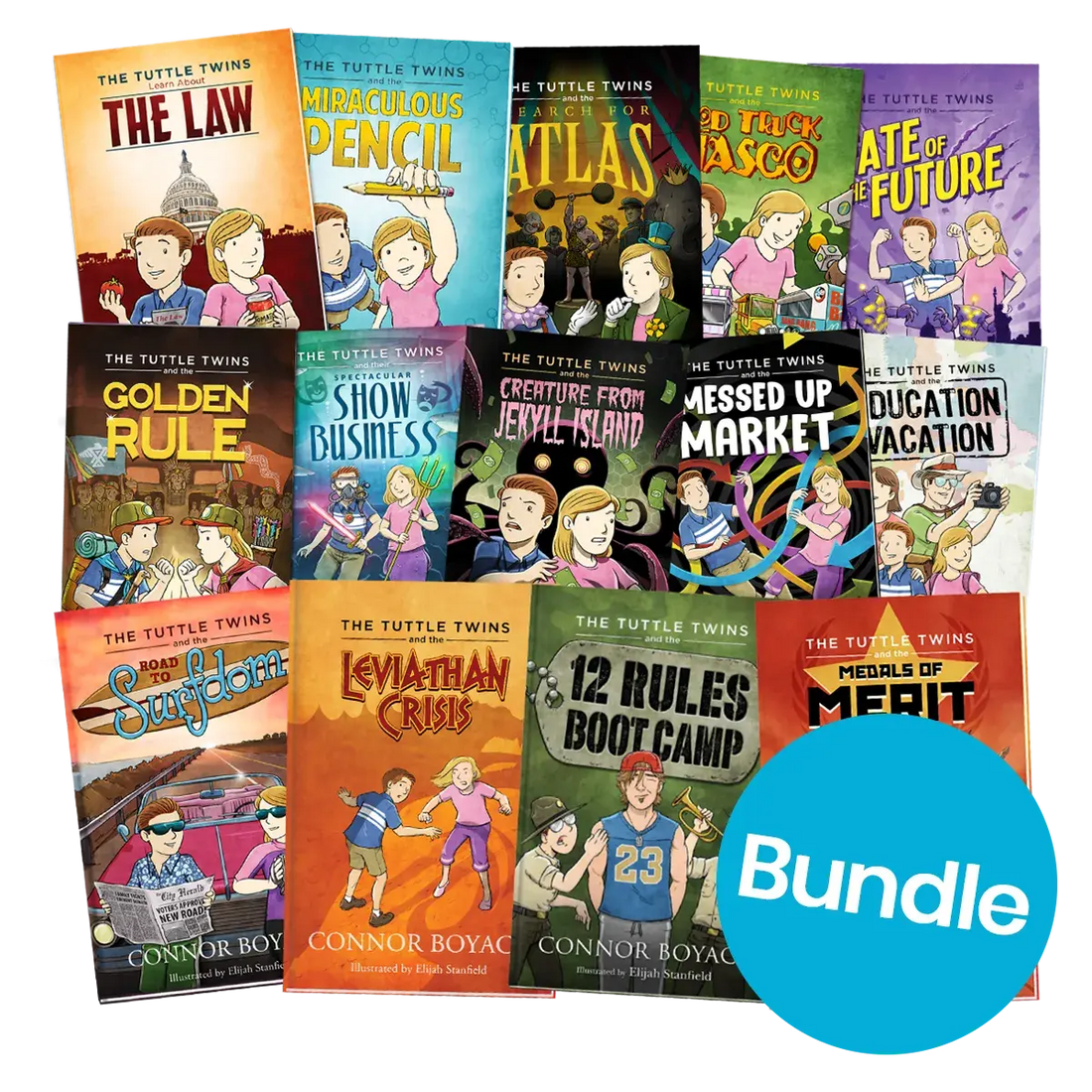
Ethan and Emily Tuttle are regular kids who keep finding themselves in the middle of ideas that change how they see the world. Across 14 story-driven books, they navigate economics, law, government, and personal responsibility as real concepts that affect everyday people.
Each book is inspired by a classic, world-changing idea: Bastiat's The Law, Hayek's The Road to Serfdom, and others, all adapted into adventures that a seven-year-old would love to finish. This is the series that makes kids ask questions at dinner that parents weren't expecting.
Why We Love It:
- 14 story-driven books that teach economics, law, government, and personal responsibility, all of them being concepts most adults were never even taught in school.
- Each title draws from a significant work of ideas, adapted into child-friendly adventures featuring Ethan and Emily Tuttle.
- Paired with PDF activity workbooks, parent guides, and audio versions for multi-modal learning.
- Works as a read-aloud for families with mixed ages, or as independent reading for stronger readers.
- Kids ages 6 to 12 consistently ask for one more chapter.
Get the Tuttle Twins Children's Series today.
America's History Series Bundle (Ages 5–12)

America's History Series Bundle
Exciting and engaging stories from America’s past
Shop NowMost history curricula and books for kids answer the question of what happened. This one answers the more important question, which is the “why”. Instead of asking kids to memorize dates and names, these two volumes walk Ethan, Emily, and your child alongside them. They talk through the ideas, philosophies, and real human stories that drove people to risk everything for freedom.
Volume 1, Seeds of Liberty, covers the journey leading up to 1776, featuring the thinkers, the arguments, and the beliefs that gave the Founding Fathers their conviction. Volume 2, Birth of a Nation, picks up from there, taking you through the Revolutionary War, the writing of the Constitution, and the ratification of the Bill of Rights. Together, they tell a complete story and an honest account of our beloved country.
For families who want their children to deeply understand American history and not just memorize it, this bundle earns its place in your home library.
Why We Love It:
- Focuses on the ideas behind America's founding so kids understand why things happened the way they did.
- Two 240-page story-based volumes that follow Ethan and Emily through America's history, from colonial roots to the Bill of Rights.
- Comes loaded with extras: 400 pages of PDF curriculum, 12 hours of audiobooks, and 8 hours of bonus video lessons.
- Works equally well as a read-aloud for younger kids or independent reading for older ones.
- Parents consistently report learning things they never knew, as this curriculum works for the whole family, not just the child.
Get the Tuttle Twins America's History Series Bundle today.
Free Market Rules: Economics Curriculum — All 30 Units (Ages 5–12)

Free Market Rules Economic Curriculum
Helps children of all ages learn about the free market
Shop NowMost adults grew up without a single real lesson in economics. We learned about dates, wars, and literary themes, but not how money works, why prices change, or what happens when governments print too much of it. Our kids deserve better than that. And the earlier they learn how the world works, the more confidently they'll grow in it.
One parent told us their 10-year-old went from asking ‘Why can’t I buy everything I want?’ to explaining scarcity at the dinner table. That’s the change this curriculum is designed to create. This award-winning economics curriculum covers 30 units and 120 lessons, walking kids through the fundamentals of how free markets work. It covers the basics of value and scarcity all the way through central banking, Keynesianism, investing, and political decision-making. It's one of the best homeschool curriculum options for families who want to cover multiple subjects in a meaningful, connected way.
Each unit is built around a real question kids can engage with:
- Why can't you always get what you want?
- How do banks work?
- What's the best economic system?
- What are taxes?
What makes it genuinely different is the structure. Every lesson comes with a quick parent guide to get you up to speed. There are separate activities for younger and older children, family discussion prompts, and optional "go deeper" material for kids who want more. It supports a range of learning styles and works for everyone, be it a science mom running unit studies or a homeschool parent following a Charlotte Mason approach.
Why We Love It:
- 30 units and 120 lessons covering the full arc of economics, including basic scarcity and value, all the way to central banking, international trade, and investment.
- Every lesson is structured for the whole family: parent intro, younger child activity, older child activity, discussion prompts, and optional deeper material.
- Works across multiple age groups simultaneously.
- Questions-based format that makes abstract concepts feel concrete and genuinely interesting to kids.
- Available in print, digital, or print-and-digital; flexible to use in a way that suits your family.
- Backed by the 30-day money-back guarantee.
Get the Tuttle Twins Free Market Rules Economic Curriculum today.
Tuttle Times Monthly Magazine (Ages 5–12)
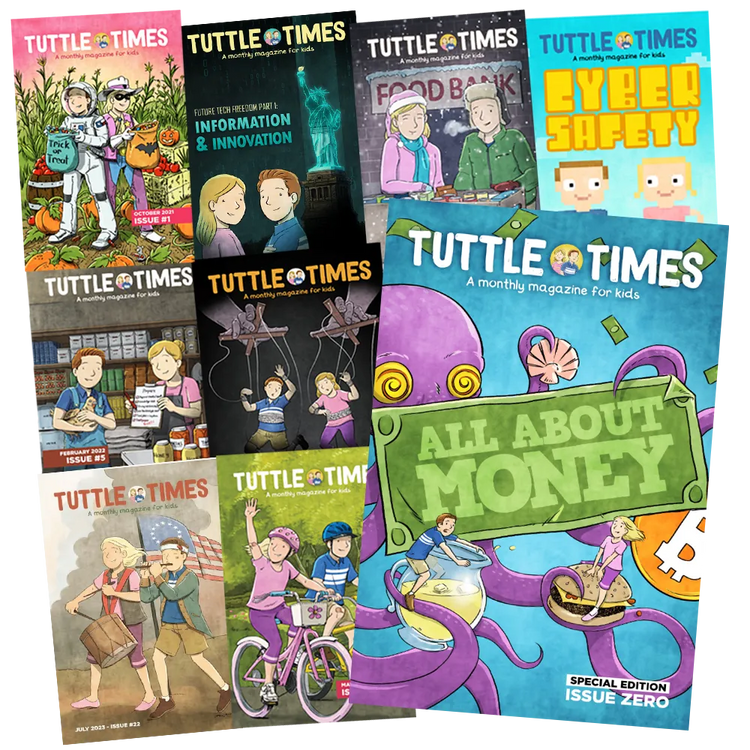
Between book reads, kids need something to keep them engaged. The Tuttle Times is a monthly subscription magazine that delivers a new short story, articles, and activities straight to your door. It's lighter than the books, but built around the same ideas, and it gives kids something fresh to look forward to each month. For families building an independent reading habit and working on reading comprehension week by week, it's an easy way to keep that habit alive.
Why We Love It:
- Monthly subscription packed with a Tuttle Twins short story, articles, and hands-on activities.
- Keeps kids engaged between book reads and reinforces key concepts in different ways each month.
- Encourages independent reading habits in a format that kids look forward to receiving.
Get the Tuttle Times Magazine Subscription for kids today.
Choose Your Own Consequence Fiction Series (Ages 10–12)
Choose Your Consequence Combo
Become a better thinker and person
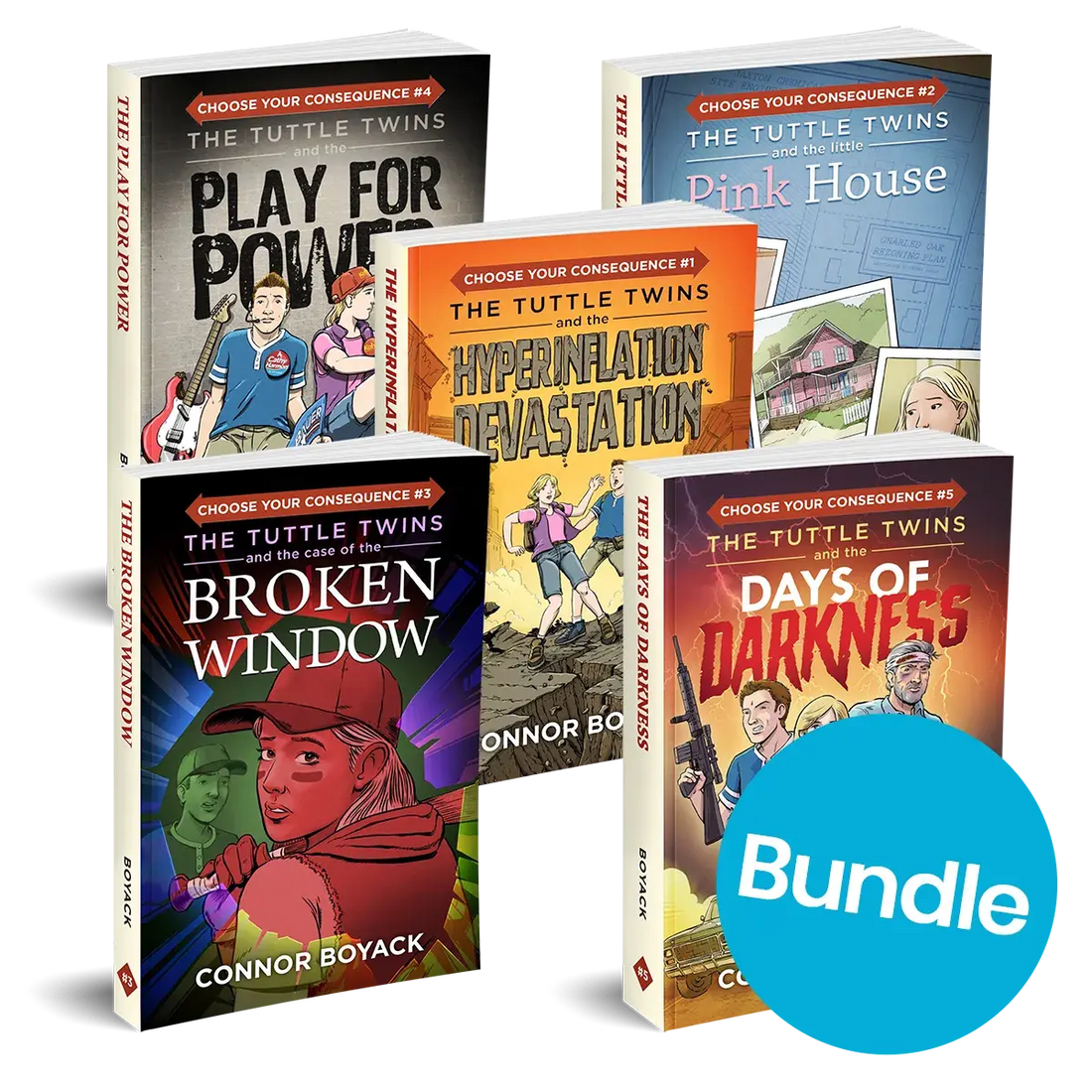
Shop NowThe Choose Your Own Consequence books are built around a simple premise: your decisions have outcomes, and you have to live with them. It's exactly the type of lessons that prepare your children for how the real world works. They are engaging stories of up to 496 pages per book, and multiple endings. Kids who say they don't like reading tend to finish these anyway. Upper elementary and middle school kids especially take to this format because the stories respect their ability to think through real problems.
Why We Love It:
- Seven interactive fiction books featuring the Tuttle Twins in adventure stories with real-world economic and political stakes.
- Multiple endings mean kids make decisions and live with the consequences; a powerful lesson in personal responsibility that no worksheet can replicate.
- High page counts with plots that are highly engaging.
- Ideal for reluctant readers who need a hook.
Get the Tuttle Twins Choose Your Own Consequence Combo today.
Best Homeschool Curriculum Resources for Teens (Ages 12 and Above)
Teenagers are fully capable of engaging with complex, real ideas, and they need materials that can fully tap into that readiness. The worst thing you can do for a teen homeschooler is hand them oversimplified content. Why? It does very little in helping them maximize their full potential.
The best resources at this stage challenge and equip young people to form and defend their own views about how the world works.
Tuttle Twins Guidebook Series

Guidebook Combo Set
Be inspired, learn from history, and think critically
Shop NowAt some point in the early teen years, kids stop accepting generic explanations and start wanting to test ideas themselves. Most teens are handed textbooks that tell them what to think, but this Guidebook Series does the opposite.
These seven illustrated hardback books are built to give teenagers the mental tools they need to navigate the real world and think for themselves. Each book digs into a different topic, such as
- How to spot a flawed argument.
- Why certain ideas keep failing throughout history.
- What makes someone a true villain or a genuine hero.
- And how our own hidden biases quietly shape the way we think.
The series features:
- Logical fallacies
- Modern villains
- Inspiring entrepreneurs
- True conspiracy
- Beware your bias
- Courageous heroes
- The world's worst ideas.
None of the books is oversimplified or watered down. Logical Fallacies teaches teens to identify 24 specific bad arguments used every day in media and politics. True Conspiracies exposes real covert operations that governments and institutions spent years hiding.
Modern Villains walks through the history of the most dangerous leaders and asks why so many people went along with them. Courageous Heroes does the opposite, showing what it looks like to stand up when it's hard.
In short, readable chapters, teens who read these books develop a sharper ability to handle arguments or conversations, and skills many adults wish they had learned earlier. For home educators who want their teens to dig deeper into how the world works, this series is a natural fit.
Why We Love It:
- Seven illustrated nonfiction guidebooks covering logical fallacies, inspiring entrepreneurs, courageous heroes, and more.
- Builds critical-thinking skills that apply across all subjects. Spotting a flawed argument is just as useful in science as in civics.
- Introduces teens to ideas they'll encounter in the real world, with the tools to evaluate them clearly and confidently.
- Pairs naturally with family dinner discussions, co-op settings, and independent study time.
Get the Tuttle Twins Guidebook Combo Set today.
Tuttle Twins Teen Bundle

Somewhere around their teen years, kids start questioning your word as they form their own independent ideas. The Teen Bundle gives them real ideas to interact with: stories where choices have consequences, and nonfiction that teaches them how to tackle a flawed argument. It also introduces ideas about money and government that most adults wish they'd learned earlier.
This bundle covers all 12 of our best-selling books on liberty, logic, and life's big choices. It includes the seven Guidebooks and the five Choose Your Own Consequence books in one purchase. Many families find this to be the right curriculum choice for teens because it covers so much ground without feeling like schoolwork.
Why We Love It:
- Includes all Guidebooks and all Choose Your Own Consequence fiction books; a complete library for teens in one purchase.
- Covers logical fallacies, economic history, entrepreneurship, courageous decision-making, and political systems.
- The fiction format keeps teens engaged while the nonfiction guidebooks build analytical depth.
- One bundle covers multiple teens in the household and is suitable for larger families.
Get the Tuttle Twins Teen Bundle today.
Tuttle Twins Academy
The Academy is an online video curriculum with 36 courses across nine categories, built with the same philosophy as the books but in a format teens are already comfortable with. It's animated, engaging, and completely free of the ideological assumptions in most standard curricula. One membership covers every teen in your household. Live classes and weekly lessons give the experience more structure for families who want consistency throughout the school year.
Why We Love It:
- Online video-based curriculum and lesson plan with 36 courses across nine categories: economics, civics, history, communication, character, and more.
- Animated lessons designed to hold teens' attention span.
- A single membership covers all teens in the household, with no per-student fees.
- Values-aligned throughout, with a focus on helping teens explore complex ideas clearly and think through them for themselves.
- Perfect for the teenager ready to understand how government, money, and society work.
Get the Tuttle Twins Academy subscription today.
Helpful Supplemental Homeschool Tools
Once you have your anchor resources in place, a few subject-specific tools can help fill in the gaps without taking over your homeschool. For math practice, families often use free or low-cost platforms like Khan Academy, Zearn, or Prodigy Math to reinforce concepts at a child’s own pace. For early reading, Reading Eggs can be helpful for phonics and beginner literacy practice, while Duolingo can add short, simple foreign language lessons to the week.
For families who want live enrichment classes, Outschool offers online classes in everything from creative writing to coding. Teachers Pay Teachers can also be useful for worksheets, unit studies, and project ideas, though parents should review materials carefully to make sure they fit their family’s goals and values.
The key is to treat these as supplements, not the center of your homeschool. Start with resources that reflect the kind of person you want your child to become, then use outside tools to support specific skills like math facts, reading practice, or electives.
Building a Homeschool Routine That Works
The right resources only go so far. The other half of successful homeschooling is building the right rhythm and a daily structure that feels sustainable for all parties involved. Here are some tips that can help.
Start Simple, and Build as You Go
New homeschoolers consistently overbuy. Sometimes it's out of the excitement of trying something new, or the decision fatigue and uncertainty around what they need. Start with one or two anchor resources and expand as you learn what works for your child.
A practical rule for Year 1: one core language arts resource, one core math resource, and one rich supplemental resource, like the Tuttle Twins children's books, is enough. You can build from there once you've found what works for your family. If you're asking yourself whether homeschooling is even the right choice, this article on whether homeschooling is hard might help.
Make Room for Discussion
The best homeschool resources prompt conversation, so a helpful tip is to be with your kids and read together, at least part of the time. Tuttle Twins books include some parent guides with discussion questions built specifically for this.
Dinner-table conversation also counts as learning. The question your eight-year-old asks about, for instance, why taxes exist after reading a Tuttle Twins book, is just as important, and you should never underestimate it.
Use Your Resources Consistently
Consistency will always win over intensity, especially with young children. Thirty focused minutes daily works better than three-hour marathon sessions twice a week. Homeschooling's greatest advantage is flexibility, and that goes both ways: follow your child's curiosity when it peaks, and give yourself permission to have a light day when it doesn't.
The families who thrive long-term in homeschooling are often the ones who show up consistently and adjust when something isn't working.
Frequently Asked Questions
At What Age Should I Start Homeschooling for my Kids?
Some families start with simple read-alouds and play-based learning before their child can even walk. Others wait until five or six to introduce anything structured. Both approaches work. What matters far more than the starting age is finding resources that meet your child’s needs. If you want to start early and keep it light, the Tuttle Toddlers board books are a great way to get started. They are great resources with good stories that plant big ideas early.
Do I Need to Follow My State's Curriculum Standards?
Requirements vary by state. Some require specific subjects or annual portfolios; others give homeschool families significant flexibility in what and how they teach. For state-by-state legal guidance, HSLDA (Home School Legal Defense Association) is the most authoritative resource available. Our Homeschooling series on several states also discusses the requirements in each state.
How Much Does it Cost to Homeschool?
Costs vary widely, from under $500 per year with free resources and one core curriculum to $3,000 or more for comprehensive programs. Bundles like the Tuttle Twins Combo Pack offer significant value and provide access to multiple resources in one package, which could help you save more.
ESA (Education Savings Account) programs in many states can also cover some of your costs, which reduces your financial liability considerably if your family is eligible. The best approach is to start small, see what works, and expand over time.
Are Tuttle Twins Resources Aligned With State Education Standards?
Yes, they are. Tuttle Twins products are designed to complement traditional educational standards while adding real-world economic, civic, and historical depth that standard curricula often skip. Each product clearly lists recommended age ranges and learning goals. They work alongside any core curriculum, be it classical, Charlotte Mason, Montessori, or traditional.
What If My Child Doesn't Like Reading — Are There Other Formats?
Tuttle Twins offers audiobooks, PDF activity workbooks, video lessons through the Academy, and the Tuttle Times monthly magazine. The Choose Your Own Consequence interactive fiction series is especially effective for reluctant readers because of its adventure-game format. If your child is still learning to read, this guide on when kids start learning to read may help.
Conclusion
The foundation of a great home education experience is access to the right resources that match your child's level and align with your family's values.
Tuttle Twins is a resource line designed to teach kids how to think about freedom, history, and personal responsibility in an age-appropriate, story-driven way. The books also range from toddler board books to teen video courses, so every age group and learning method is considered.
The hardest part is usually the beginning, making the first decision, buying the first resource, and having the first real conversation with your kids about how the world works.
Explore age-matched bundles at the Tuttle Twins Homeschool Hub and find the right fit for your family today. If you're still early in the process, our guide to starting homeschooling is another helpful resource.