




The Best American History Books for Kids of Different Age Groups
If you’ve ever picked up a history book for your kids and thought, “There’s no way they’re finishing this, you’re not alone.
A lot of history books focus heavily on dates, battles, and names, but they often skip the part families care about most: why any of it actually matters. Why were the colonists willing to risk everything for self-governance? What did the founders actually disagree about, and why does it still affect us today? Those are the questions that make history worth learning, and most books never get there.
The Tuttle Twins America's History series takes a different approach entirely. It puts the ideas front and center and tells those stories in a way that's honest about the inspiring parts and the difficult ones.
Think of these books as conversation starters. They inform and open up the kind of dinner-table discussion you actually want to have with your kids. Before we get into it, let's quickly discuss what makes a great American history book for kids.
What Makes a Great American History Book for Kids?
Before you pick a history book for your kids, it’s important to know what actually makes one worth their time. Here's what separates a great American history book from one that collects dust on the shelf:
1. It Teaches the "Why," Not Just the "What"
Ask most kids what caused the American Revolution, and you'll get silence because most books never explain it.
The best history books for children go deeper than dates and events. They explain the ideas that drove those events: why the founders designed the Constitution the way they did, what they feared, and what they hoped to protect. Kids forget dates, but they often remember ideas that connect to something that matters to them personally.
2. It's Honest Without Being Cynical
Great history books don't pretend certain events didn't happen, but they also don't reduce the entire arc of American history to its worst moments, leaving kids with nothing but cynicism and confusion.
The books worth reading help kids acknowledge the failures and injustices in America's past while also recognizing the real progress that the founding principles eventually made possible. Both things can be true at once, and kids are capable of understanding that.
3. It's Actually Readable and Engaging
Story-driven books win every time. Kids don’t remember what they’re told to memorize, but they do remember stories that actually pull them in.
When history is told through vivid characters, relatable dialogue, and scenes that feel alive, kids carry it with them. Reluctant readers who would never sit down with traditional textbooks often find themselves hooked once they find characters they care about.
4. It Works for Family Read-Alouds
For homeschooling families, the best history books give you something to actually talk about together. It's a major plus if it includes companion activities, discussion questions, or curriculum materials that make your life as the parent leading the learning easier. Look for chapters that end with a question worth discussing during lunch hours or family gatherings.
The Best American History Books for Kids: Our Top Picks
Every book featured below is part of the Tuttle Twins America's History series. Each review follows a consistent format, and we discuss what the book covers, what makes it stand out, and an honest take on why families keep coming back to it.
America's History, Volume 1: Seeds of Liberty (1215-1776)
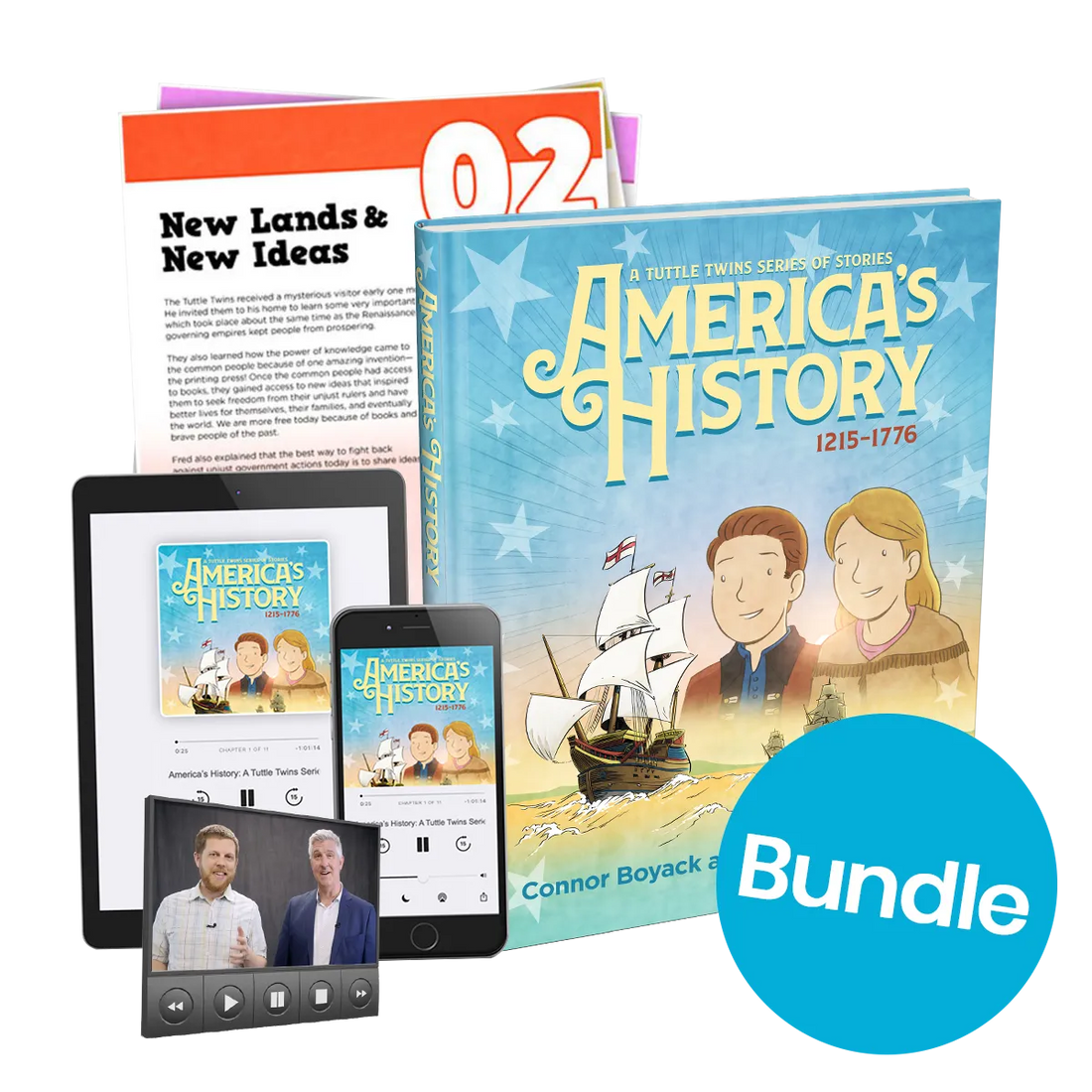
America's History, Volume 1
Lessons of history that shape our world today
Shop NowVolume 1 opens with a scene most kids will immediately connect with: Ethan and Emily Tuttle playing the swimming pool game of Marco Polo. From there, the book traces the real Marco Polo's story: how he traveled the Silk Road, how free trade created new possibilities, and how those possibilities eventually led to American independence.
That opening gives you a good sense of how the book works. Instead of starting at Plymouth Rock or the Boston Tea Party, this book takes the long view, beginning with the Magna Carta in 1215 and building forward from there. It goes through the Protestant Reformation, the first colonial voyages, John Locke, the Glorious Revolution, and the Sons of Liberty, all the way to the Declaration of Independence in 1776.
Throughout the book, the focus remains on helping kids understand the ‘why’ behind these events: what was happening, what ideas were driving them, and why those ideas still matter today. Each chapter leads with a story first, then deepens into the principles, with maps, timelines, and illustrated sidebars along the way. Every chapter also closes with a "Let's Talk About It" section of open-ended questions worth bringing to the dinner table.
Age Range: 7 to 13
Why We Love It:
- The Marco Polo opening hooks kids before they realize they're learning history.
- Story comes first; kids are invested in the ideas before they're asked to think about them.
- The "Let's Talk About It" questions are worth discussing and great conversation starters.
- It’s honest about important historical events without leaving kids in cynicism.
- The bundle is complete enough that you're not building lesson plans from scratch.
Get the Tuttle Twins’ America’s History, Volume 1 book today.
America's History, Volume 2: Birth of a Nation (1776-1791)
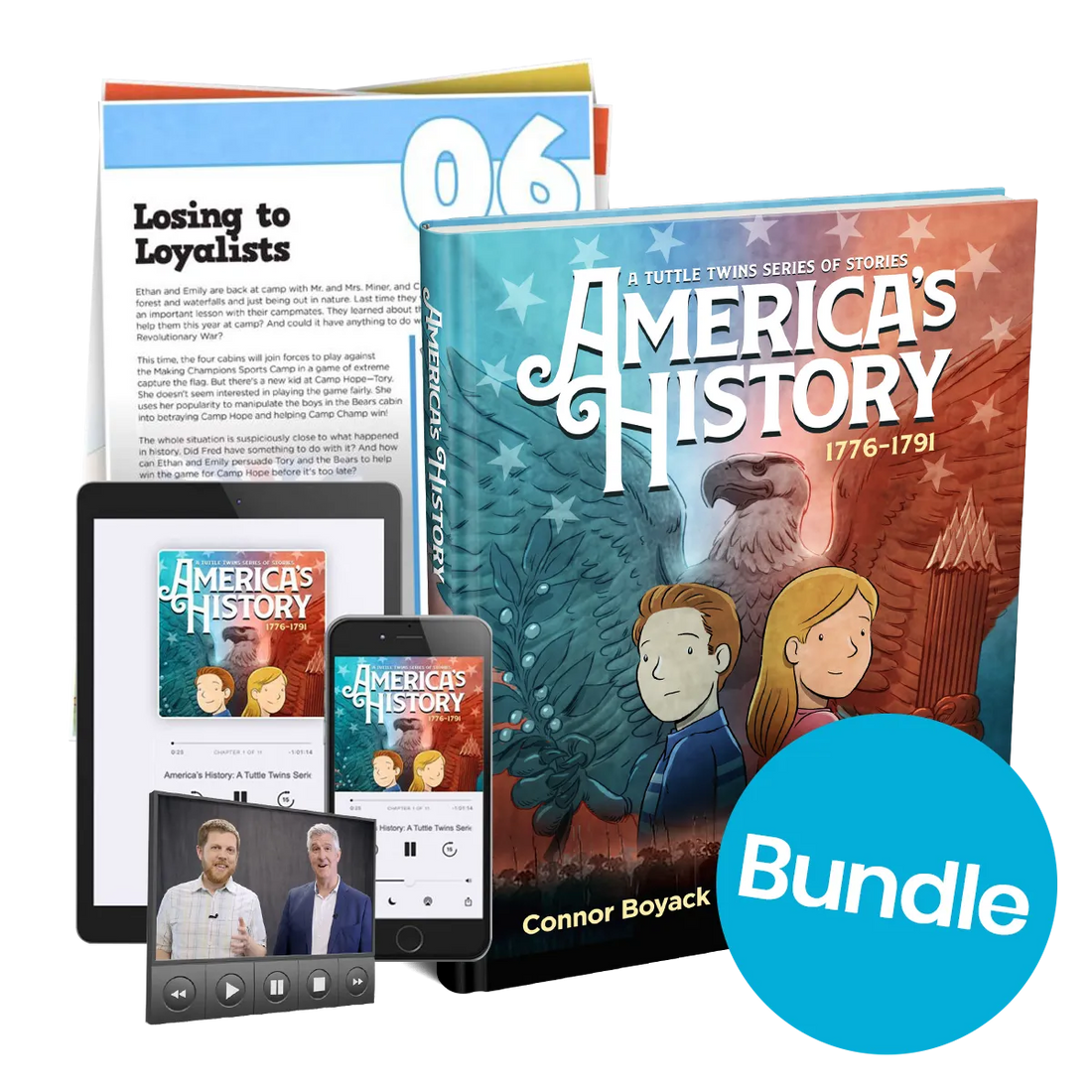
America's History, Volume 2
Exciting and engaging stories from America’s past
Shop NowWhile Volume 1 answers the question of how America came to exist, Volume 2 tackles the harder one: what do you actually do once you've won your independence?
This volume picks up where the first left off, covering the Revolutionary War, the creation of the Constitution, the leadership of George Washington, and the ratification of the Bill of Rights. Although that arc sounds straightforward on paper, the book does what most history curricula never bother to do: it shows kids that none of it was inevitable. There were many debates, and the people involved were working through difficult problems about how to build a government that could actually last.
Like Volume 1, the story follows Ethan and Emily Tuttle, and the same structure applies throughout. There are discussion questions at the end of each chapter that are worth sitting down as a family to discuss. The goal, as always, is to help kids understand not just what happened, but why it matters and how it connects to their lives today. Readers leave with a clear sense of what the founding generation risked and what they learned through the process of building a nation from scratch.
Age Range: 7-13
Why We Love It:
- Same flexible, narrative-based format as Volume 1.
- Kids get to understand why the Constitution is structured the way it is.
- The economic realities of the Revolutionary War, such as inflation, shortages, and sacrifice, give kids a side of the story most books skip entirely.
- Picks up seamlessly from Volume 1, making the two books feel like one cohesive story and not separate curricula.
Get the Tuttle Twins’ America’s History, Volume 2 book today.
America's History, Volume 1 & 2 Curriculum (PDF)
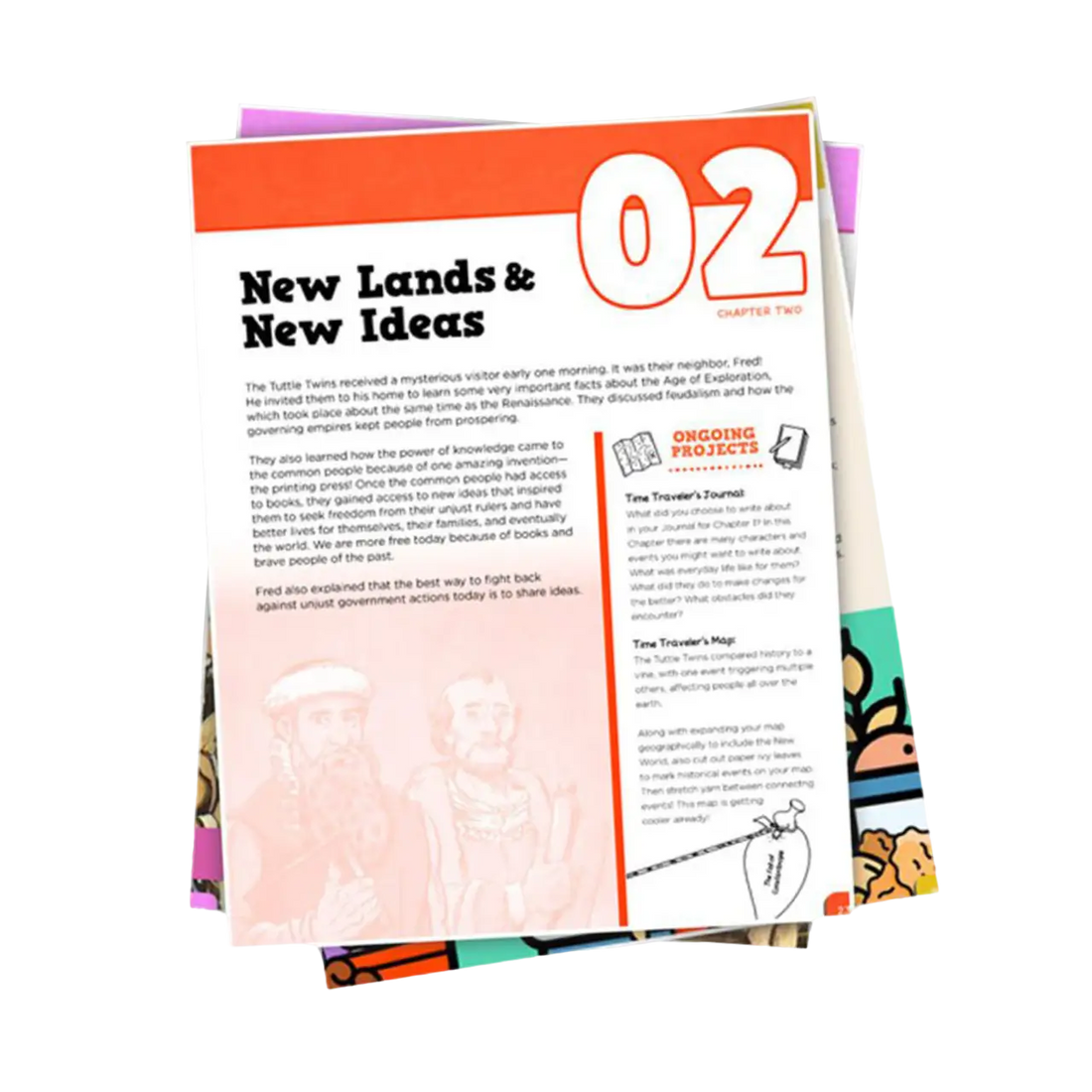
America's History, Volume 1 & 2 Curriculum (PDF)
Embark on a journey leading up to 1776
Shop NowWhile the books, volumes one and two, build understanding through story, the PDF curriculum contains hands-on projects, written activities, and discussion questions that test the comprehension of your kids between reading sessions. They cover the same ground, including the Revolutionary War, the structuring of the new government, the economic hardships, and the creation of the Constitution and the Bill of Rights.
This curriculum is also useful for families at different stages. If you're homeschooling and want a ready-made lesson plan that aligns chapter by chapter with the book, the PDF is already organized that way. If you're using the book as a supplement to another curriculum, you can dip into the activities selectively without following a set sequence. And if you have children at different ages working through the same material, the written components naturally fit as well. Older kids can take on the longer projects while younger ones participate in the discussion questions and hands-on activities.
This curriculum is designed to be used alongside America’s History Volume 1 & 2 bundle, along with the history audiobook and bonus videos. If you own the books and want to add the curriculum, it's available separately.
Age Range: 7-13
Why We Love It:
- Turns the book's ideas into something kids actively work with.
- Already organized to align with the books chapter by chapter, so no lesson planning from scratch.
- Works across a wide age range without modification.
- A full semester's worth of activities in a single printable PDF.
- Included in the bundle, so there's no reason to skip it.
Get the Tuttle Twins’ America's History, Volume 1 Curriculum and Volume 2 Curriculum today.
How to Use These History Books in Your Homeschool

Buying a great book only covers half of the learning experience. Here's how families are using the Tuttle Twins America's History series day-to-day, depending on where they are in their homeschool journey:
1. As a Spine Curriculum
Volume 1 works beautifully as a semester-long American history spine for ages 7 to 13. Move through the chapters chronologically, using the PDF curriculum as your daily lesson plan. The curriculum is already organized to align with the book's pacing, so you're not piecing together a schedule from scratch. Use the audiobook on days when you want a read-aloud experience, or let it run during a car ride to a co-op. Many families complete a volume over about 16-18 weeks at a comfortable pace of two to three chapters per week.
If you're looking for more context on structuring your overall homeschool approach, the Tuttle Twins Homeschool Hub offers resources to help you plan. And if you're just starting, our guide on how to start homeschooling will walk you through the basics.
2. As a Read-Aloud
The books work beautifully as a family read-aloud for mixed ages. Younger kids (5 to 7) can follow along with the audiobook while older siblings read along in the hardcover. Older kids (10 to 13) can take notes on the discussion questions or work through the written curriculum independently.
The books also pair naturally with other read-aloud choices from the Tuttle Twins children's series collection, if you want to rotate in other titles.
Tips for Getting the Most Out of the History Books:
- Use the discussion questions at the end of each chapter as dinner table prompts.
- Some of the best conversations happen when you're not sitting in "school mode."
- Watch the bonus videos before or after reading a chapter. Kids who see the concepts on screen first often understand the text more easily.
- Don't skip the PDF curriculum. It includes hands-on projects and activities, and doing them makes the ideas stick in ways that reading alone doesn't.
- If you're working with a reluctant reader, start with the audiobook. Let the story do its job first, then bring in the written components once they're already hooked.
FAQs
At What Age Is it Best to Start Teaching Kids American History?
Most kids are ready for introductory American history concepts around ages 6-8, with deeper engagement from ages 9-13. Tuttle Twins America's History is designed for ages 7-13, but works as a family read-aloud for younger children (5-plus) when parents guide the discussion. The audiobook is especially helpful for younger listeners who aren't reading independently yet.
How Is Tuttle Twins Different from a Regular History Textbook?
Standard textbooks focus on memorizing events, dates, and people. Tuttle Twins America's History focuses on the ideas behind those events, including why they happened and the principles that drove the people involved. It's written as a story-driven narrative, which makes it far more engaging and memorable. Kids retain the ideas because the ideas are connected to characters and situations they care about.
Can I Use Tuttle Twins’ History Books if I Don't Homeschool?
Absolutely. Many families use the Tuttle Twins books as a supplement to public or private school education, particularly for kids who find classroom history surface-level. The books work well for summer reading, evening read-alouds, or weekend family time. The audiobook option makes it easy to fit in during car trips or commutes without adding anything to your plate.
What's Included in the Bundle? Is it Just the Book?
Each bundle includes the hardcover book plus: 200 pages of PDF curriculum and activity worksheets, a professionally recorded 6-hour audiobook, and 4 hours of bonus video lessons. You're getting a complete semester of American history education, not just a book.
How Long Does it Take to Complete One Volume?
At a comfortable pace of two to three chapters per week (each chapter averages 20-30 pages), one volume might take approximately one semester, which is about 16 to 18 weeks. Families who go more intensively can complete a volume in 8-10 weeks. The companion curriculum is designed to align with the slower, semester-length pace, giving you time for discussions, activities, and projects without feeling rushed.
Conclusion
The best American history books for kids explain the ideas behind the events and help kids draw real connections to their own lives. You're right to want something better because the history your kids learn shapes how they see their country, their rights, and their own place.
For the most complete experience, start with the America's History Vol. 1 & 2 Bundle. It gives you everything you need for a full semester of story-driven, ideas-first American history education, with books, curriculum, audio, and video all in one package. If you want to go deeper across multiple subjects, we have more resources on economics, law, and entrepreneurship to build a comprehensive foundation.
At the end of the day, most parents aren’t just looking for more history facts. They want their kids to understand how the world works, ask better questions, and feel confident talking about big ideas. That’s where the right kind of history book makes all the difference.